Simulating multiple casks#
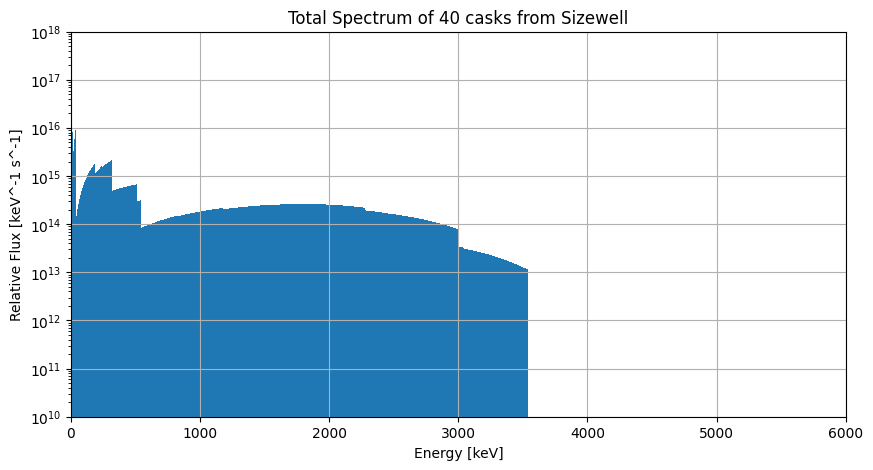
For a more complicated simulation, we can include multiple casks of SNF and look at the combined spectrum.
For example, we could assume 40 casks of SNF from the Sizewell reactor, with the following removal times:
10 casks removed 0.5 years ago
10 casks removed 5 years ago
10 casks removed 10 years ago
10 casks removed 20 years ago
Each cask has a mass of 10 tonnes.
To simplify the simulation, instead of simulating 10 individual 10-tonne casks for each removal time, we can just simulate one 100-tonne cask at each time. We’re also assuming the isotope proportions are the same for each cask, based on the input file.
from snf_simulations.cask import Cask
from snf_simulations.data import get_example_tbq_path
import matplotlib.pyplot as plt
import numpy as np

cask = Cask.from_tabqfile(
    get_example_tbq_path(),
    total_mass=10000,  # 10 tonnes
    name='Sizewell',
)
cooling_times = [0.5, 5, 10, 20]

spectra = []
for cooling_time in cooling_times:
    total_spec = cask.get_total_spectrum(cooling_time=cooling_time)
    spectra.append(total_spec)

# Now combine all the spectra into one by adding them together
spec_multiple = spectra[0]
for spec in spectra[1:]:
    spec_multiple = spec_multiple + spec

# Plot the spectrum
figure = plt.figure(figsize=(10, 5))
axes = figure.add_subplot(1, 1, 1)

axes.bar(
    x=spec_multiple.energy[:-1],
    height=spec_multiple.flux,
    width=np.diff(spec_multiple.energy),
)

axes.set_xlim(0, 6000)
axes.set_ylim(1e10, 1e18)
axes.set_xlabel("Energy [keV]")
axes.set_ylabel("Relative Flux [keV^-1 s^-1]")
axes.set_title(f"Total Spectrum of 40 casks from {cask.name}")
axes.set_yscale("log")
axes.grid()

plt.show()
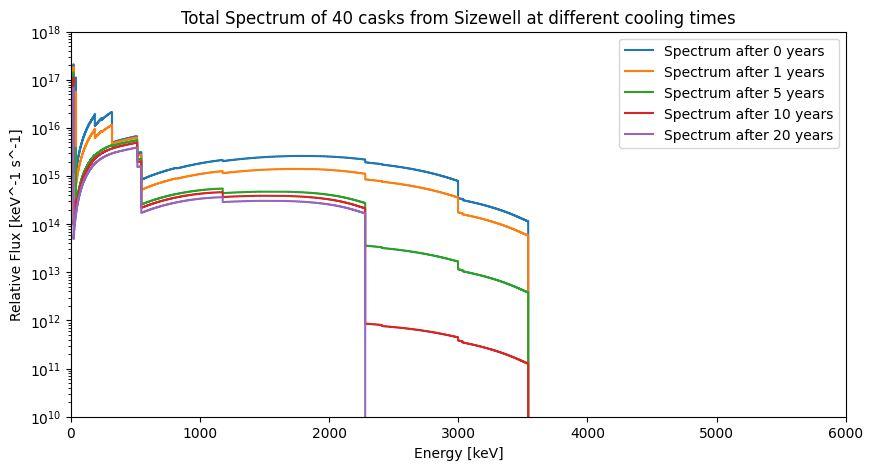
We can also simulate how this total spectrum would decay over time.
cask = Cask.from_tabqfile(
    get_example_tbq_path(),
    total_mass=10000 * 10,   # 100 tonnes = ten 10-tonne casks
    name='Sizewell'
)
cask_cooling_times = [0.5, 5, 10, 20]
simulation_times = [0, 1, 5, 10, 20]

spectra = []
for simulation_time in simulation_times:
    new_ages = np.array(cask_cooling_times) + simulation_time
    time_spectra = []
    for cooling_time in new_ages:
        spec = cask.get_total_spectrum(cooling_time=cooling_time)
        time_spectra.append(spec)
    total_spec = time_spectra[0]
    for spec in time_spectra[1:]:
        total_spec = total_spec + spec
    spectra.append(total_spec)

# Plot the spectra
figure = plt.figure(figsize=(10, 5))
axes = figure.add_subplot(1, 1, 1)

for spec, simulation_time in zip(spectra, simulation_times, strict=True):
    axes.step(
        spec.energy[:-1],
        spec.flux,
        where="post",
        label=f"Spectrum after {simulation_time} years",
    )

axes.set_xlim(0, 6000)
axes.set_ylim(1e10, 1e18)
axes.set_xlabel("Energy [keV]")
axes.set_ylabel("Relative Flux [keV^-1 s^-1]")
axes.set_title(
    f"Total Spectrum of 40 casks from {cask.name} at different cooling times"
)
axes.set_yscale("log")
axes.legend()

plt.show()